


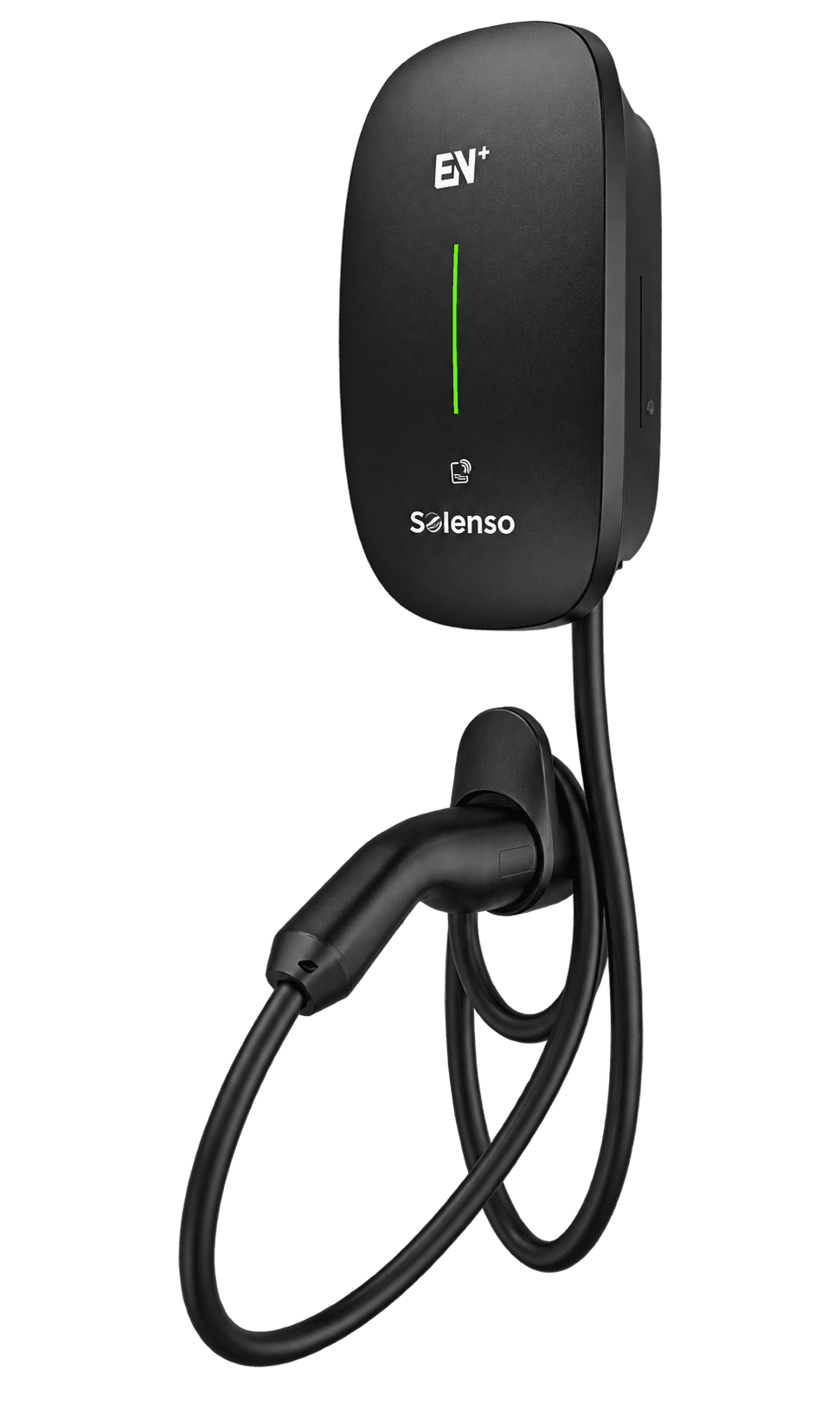
EV charger EV+ 7 / 11 kW
THE HOME WALLBOX THAT CHARGES YOUR VEHICLE FROM THE SUN

Charging Power
7 kW single or 11 kW three-phase

Built-In Protection
30 mA type A + 6 mA DC

Open Control
OCPP 2.0.1-J and Modbus

Ingress Protection
IP65 and IK10
Two power levels, one enclosure
AC7000 single-phase 230 V, 32 A, 7 kW. AC011K three-phase 400 V, 16 A, 11 kW. Tethered Type 2 cable, black plastic enclosure of 365 × 201 × 99.5 mm, wall mounted or pole mounted as an option.
Charging from surplus solar power
The charging current follows the solar power available, so the vehicle charges without drawing on the grid. Dynamic load balancing shares the power between the charger and the rest of the home without exceeding your supply limit.
Three ways to start a charge
Plug in directly, use a Mifare Classic RFID card or the Solenso app, with off-peak scheduling. Green, yellow and red indicator on the front panel.
Open and upgradable communication
Wi-Fi, Ethernet and Bluetooth as standard, 4G as an option. OCPP 1.6 JSON and 2.0.1-J by update, RS485 Modbus RTU and TCP to join an energy management system.
Safety and durability
Built-in 30 mA type A and 6 mA DC residual current protection, plus overcurrent, earth fault, surge, over and under voltage, over and under frequency and over temperature protection. IP65 enclosure, IK10 impact resistance, reinforced insulation, from -30 to +50 °C.
Cybersecure charging system
EN 18031-1 compliance and third-party penetration testing, alongside the CE, CB and RoHS markings.
*Product images shown may represent the product range, or be for illustration only, and may not depict the product exactly.
Technical specifications
| 7 kW single-phase | 11 kW three-phase | |
|---|---|---|
| Electrical specifications | ||
| Power supply | 1P+N+PE | 3P+N+PE |
| Rated voltage | 230 V AC | 400 V AC |
| Rated current | 32 A | 16 A |
| Rated power | 7 kW | 11 kW |
| Frequency | 50 Hz | |
| Power measurement accuracy | 2 % | |
| General characteristics | ||
| Charging connector | Tethered Type 2 cable | |
| Enclosure material | Plastic | |
| Size (H × W × D) | 365 × 201 × 99.5 mm | |
| Colour | Black (PANTONE Black C) | |
| Installation | Wall mounted, or pole mounted as an option | |
| Interface and start-up | ||
| Indicator | Green, yellow and red LED | |
| RFID reader | Mifare Classic ISO/IEC 14443-A, DESFire Duox and FeliCa as options | |
| Start modes | Plug in, RFID card or app | |
| Communication | ||
| Wi-Fi, Ethernet and Bluetooth | Standard | |
| Wi-Fi, Bluetooth and 4G | Optional | |
| OCPP | 1.6 JSON and 2.0.1-J, by update | |
| Local communication | RS485, Modbus RTU and Modbus TCP | |
| Safety | ||
| Built-in residual current protection | 30 mA type A and 6 mA DC | |
| Ingress protection | IP65 | |
| Impact resistance | IK10 | |
| Electrical protection | Overcurrent, residual current, earth fault, surge, over and under voltage, over and under frequency, over temperature | |
| Environment and warranty | ||
| Operating temperature | -30 to +50 °C | |
| Operating humidity | 5 to 95 % | |
| Operating altitude | ≤ 2000 m | |
| Packaging | Carton without foam | |
| Warranty | 2 years | |
| Standards and markings | ||
| Markings | CE, CB, RoHS, EN 18031-1 | |
| Charging station safety | EN IEC 61851-1:2019, EN IEC 61851-21-2:2021 | |
| Electromagnetic compatibility | EN IEC 61000-6-1:2019, EN IEC 61000-6-3:2021, EN 301 489-1, -3 and -17 | |
| Radio and exposure | EN 300 328, EN 300 330, EN IEC 62311:2020 | |
Frequently asked questions
Should I choose a 7 kW or an 11 kW EV charger?
It depends on your supply above all. A 7 kW charger connects to a single-phase 230 V supply and suits the vast majority of homes. The 11 kW version requires a three-phase 400 V supply, which not everyone has. In practice, 7 kW puts back around 40 km of range per hour of charging and 11 kW around 65 km, based on a consumption of 17 kWh per 100 km. For a vehicle covering less than 100 km a day, 7 kW is ample, since the car sits still all night.
Compare both EV chargersHow long does it take to charge an electric car?
For a 60 kWh battery taken from 20 to 80 %, that is 36 kWh to deliver, expect around 5 hours on a 7 kW charger and 3 hours 20 on an 11 kW one. Charging an empty battery in full takes around 8 h 30 at 7 kW and 5 h 30 at 11 kW. The power actually accepted also depends on the vehicle's onboard charger, which some models limit to 7.4 kW even on a three-phase unit.
Can an EV charger be installed outdoors?
Yes. The enclosure is rated IP65 with IK10 impact resistance and operates from -30 to +50 °C. It mounts on a wall or on an optional pole. The manufacturer still recommends shelter from driving rain. Installation remains a job for a qualified electrician: it calls for a dedicated circuit, 10 mm² and a 40 A type A residual current breaker for the 7 kW unit, 2.5 mm² and 20 A for the 11 kW one.
Ask an installer for adviceCan I charge my car with my solar panels?
That is the main point of this charger. It matches its charging current to the photovoltaic power available and charges from the surplus rather than the grid. Dynamic load balancing avoids exceeding your supply limit when the home is already drawing power, and off-peak scheduling takes over on sunless days. The OCPP 2.0.1-J and Modbus protocols allow it to join an energy management system that is already installed.
See Solenso solar panels*Warranty: 24 months from the date of sale to the end customer, parts and labour according to the Solenso warranty terms.